Interface Critique

The anthology Interface Critique is an attempt to interrogate apparatuses and applications. How can we examine the dissolving intersections between human and machine? How can we comprehend the contexts and conditions of their production? Where and how do these interfaces govern and guide us? How do they shape our perception of our surroundings and of our world? And what significance could the interface have in the context of current technological, social and economical developments?

The book discusses the interface as a dynamic cultural phenomenon, opening up a multidisciplinary discourse ranging from engineering and coding to design and communications, from digital humanities and philosophy to media studies and literature. Continue reading

International Conference: Situation Space. How Spatial Images Define the User’s Disposition (Berlin, 12./13.01.2017)

Situation Space. How Spatial Images Define the User’s Disposition

International conference, January 12th and 13th 2017
Cluster of Excellence Image Knowledge Gestaltung
Sophienstrasse 22a, 10178 Berlin,
Central Laboratory (2nd courtyard, 2nd floor)
www.situation-space-conference.org

Contemporary imaging, sensor and display technologies have turned viewing predominantly into using. Interacting with visual devices and interfaces such as virtual reality headsets, augmented reality apps or navigation systems situate users in space both within and beyond the boundaries of the screen, for instance when playing Pokémon Go on a smartphone, or when superimposing medical images on a patient’s body. Narrative media such as stereoscopic movies, volumetric cameras or curved displays also require a visual practice that spatially aligns image and viewer. In the case of a stereoscopic projection, for example, the spatial impression of the image is most intelligible and convincing if the physical position of the viewer corresponds with the camera-viewpoint.

Continue reading

CfP: „Interfaces & Implizites Wissen“ – 2. Workshop der AG Interfaces

Datum: 08./09. Juni 2017
Veranstaltungsort: Rheinische Friedrich-Wilhelms-Universität Bonn
Veranstalter: AG Interfaces in Kooperation mit der Abteilung Medienwissenschaft der Universität Bonn
Konzeption & Organisation: Christoph Ernst, Regina Ring
Datum: 08./09. Juni 2017
Einsendeschluss CfP: 15. März 2017

Call for Papers (Pdf): Interfaces & implizites Wissen

›Implizites Wissen‹ ist im Kontext kritischer medienhistorischer und sozialer, politischer und ästhetischer Interfacebetrachtungen, wie sie Andersen/Pold (2011), Galloway (2012), Chun (2013), Hookway (2014) und Hadler/Haupt (2016) fordern, von elementarer Bedeutung. Meist in Relation zum menschlichen Körper formuliert, ist implizites Wissen für das Gelingen von Wahrnehmung und Handlungen eine wesentliche Bezugsgröße, die sich als »stummes« Wissen nur schwer formalisieren lässt (Polanyi 1966 [1985]). Zu bedenken ist dabei jedoch, dass implizites Wissen durch Gesellschaft und Kultur vermittelt wird. Über das körperliche Wissen hinaus schließt der Begriff soziales Regel- und Beziehungswissen genauso ein wie kollektive Formen des Wissens, die nicht exklusiv auf ein Individuum zurechenbar sind, sondern innerhalb von Gemeinschaften zirkulieren (Collins 2010). Begreift man Interfaces vor diesem Hintergrund als Orte komplexer Vermittlungsleistungen zwischen Mensch, sozialer Realität und zunehmend allgegenwärtigen computerbasierten Mediensystemen, gewinnt die Frage nach der Beziehung von Interfaces zu implizitem Wissen auf verschiedenen Ebenen an epistemologischer Relevanz und kritischer Bedeutung.
Continue reading

CFP: NECS Conference 2017. Sensibility and the Senses

CALL FOR PAPERS

The NECS 2017 Conference
SENSIBILITY AND THE SENSES. Media, Bodies, Practices

Paris, France
29 June to 01 July 2017
Hosted by the Université Sorbonne Nouvelle – Paris 3

Pre-Conference
27 and 28 June 2017
Hosted by the Université Paris Diderot – Paris 7

Keynote presentations
Centre Pompidou
Grand Amphithéâtre de la Sorbonne

Deadline for submissions: 31 January 2017

Please note that the membership fee must be paid before submission (see www.necs.org/faq for more details). Pay the fee in January to get access for the full calendar year.

The question of the relationship between media, bodies, and the senses cuts across the entire history of media theories. Since their first appearance, technical media such as telegraphy, photography, gramophone, film, typewriter, the telephone, radio, and then television, computer, internet, as well as a wide variety of cultural techniques for the recording, processing, and transmitting of information have been analyzed taking into consideration their relationships with the human body and its sensory organs. Concepts such as “organ projection,” “prosthesis,” “innervation,” “extension,” and “interface” have been used to describe the contact and the interaction between human organisms and technical apparatuses with their various degrees of hybridization, which in turn have generated a whole series of utopian and dystopian visions of a future “post-human” condition. And while the very notion of medium is strictly related to the problem of sensory perception (since it finds one of its origins in the Latin translation of a Greek term, metaxy, which was used by Aristotle in order to indicate the material intermediary entities that make perception possible), the body itself (with its expressive face, its sensitive skin, and its meaningful gestures and movements) has often been considered a sort of primary medium, a crucial reference point in order to understand the very nature of mediation.

Continue reading

Workshop: Immersion – Transition – Figuration. Die neuen Grenzen des Ich

Veranstaltung: Immersion – Transition – Figuration. Die neuen Grenzen des Ich
(Köln, 01.-02.12.2016)
Workshop der a.r.t.e.s. Graduate School for the Humanities, Universität zu Köln
Aachener Str. 217 | 50931 Köln | artes.uni.koeln.de
Organisiert von Thiemo Breyer (Köln) und Dawid Kasprowicz (Lüneburg)
Öffentlich. Eintritt frei

Abstract:
Die Vorstellung eines „Eintauchens“ oder gar „Versinkens“ in virtuelle Welten hat unter dem Begriff der Immersion eine abwechslungsreiche Geschichte hinter sich. Sei es das Hineingezogen-Werden in einen virtuellen Bildraum, die Multisensibilität von technischen Endgeräten oder das Versinken des Spielers in Computerspielwelten: Begleitet werden all diese Figuren von einer Steigerungslogik, die immer wieder die Immersion an den Horizont interaktiver Erlebnisse stellt. Im Hintergrund steht die Idee, ein vollständiges Dasein („Presence“) jenseits einer physisch verankerten Realität zu proklamieren. Mit der neuen Ausweitung von Virtual-Reality-Anwendungen im Unterhaltungssektor, wie in diversen Wissenschaften, tauchen immersive Erlebnisse sowohl als empirischer Forschungsgegenstand als auch als dokumentarische Erfahrungsform auf. Sie referieren auf zentrale Bereiche der Identität, der Personalität und nicht zuletzt der Körperlichkeit eines heute noch unscharfen Gegenstandes namens „digitales Subjekt“. Der Workshop will der Frage nachgehen, wie der diffuse Begriff der Immersion inmitten dieser digitalen Wissenskulturen zu positionieren ist.

Continue reading

CfP: Why VR? Why Now?

CALL FOR PAPERS
Why VR? Why Now?: A critical discussion of Virtual Reality experiments and experiences*

Journal of Transformative Technologies
http://www.ttrujournal.com.au/call-for-papers/

Abstracts due:
February 10th, 2017

Issue Editors:
Simon Young, simon@lithodomosvr.com <mailto:simon@lithodomosvr.com>
Thao Phan, thao.phan@unimelb.edu.au <mailto:thao.phan@unimelb.edu.au>
Andrew Lynch, andrew.lynch1@unimelb.edu.au <mailto:andrew.lynch1@unimelb.edu.au>

The ‘virtual insanity’ predicted by Jamiroquai’s Jay Kay in 1997, has certainly arrived, bringing with it an unprecedented range of VR technologies and software to experience for the contemporary media consumer. While it remains to be seen which of the multitude of competing technologies (Sony’s PlayStation VR, HTC’s Vive, Samsung’s Gear VR or even the humble Google Cardboard) will reign supreme in the consumer market, there has never been a more pressing time for scholarly analysis of how this state of ‘virtual insanity’ came to be, and how we might better comprehend its significance for the academic areas of media, screen and cultural studies.

Continue reading

Bericht zum AG-Workshop „Politiken des Interface“ (Potsdam)

Am 10. Juni 2016 fand in den Räumlichkeiten des ZeM (Brandenburgisches Zentrum für Medienwissenschaften) in Potsdam der erste Workshop der AG Interfaces statt. Unter dem Titel “Politiken des Interface” setzten sich Mitglieder der AG mit der Frage auseinander, welche Machtkonstellationen und Politiken des Interface in unterschiedlichen computerbasierten Anwendungskontexten am Werk sind und wo sich Ansatzpunkte der Kritik ausmachen lassen. Dabei wurden neben diskursgeschichtlichen Annäherungen vor allem ästhetische Politiken und Fragen der Relation von Interfaces und Körpern diskutiert.

Continue reading

Workshop „Screen Operations. Conditions of Screen-based Interaction“

Ort: Berlin

Veranstaltungsort: Sophienstrasse 22a, 10178 Berlin
Central Laboratory (2nd courtyard, 2nd floor)
Veranstalter: Interdisciplinary Laboratory Image Knowledge Gestaltung
Datum: 13.-14. Juli 2016

Screen-based technologies increasingly merge the levels of action and perception. With image production and transmission being possible in real time, screens are no longer spatially fixed and temporally subordinated devices that display static images, but are increasingly integrated into visual practices. The correlation of screen and operation in graphical user interfaces, touchscreens or augmented reality applications, turns the viewer first and foremost into a user. The workshop investigates the relationship of screen and operation in visual culture, interaction and architectural design, computer history, medicine and warfare. We will discuss the aesthetic, epistemic and operational modalities of screen operations in order to trace their political, technological and historical implications.

Continue reading

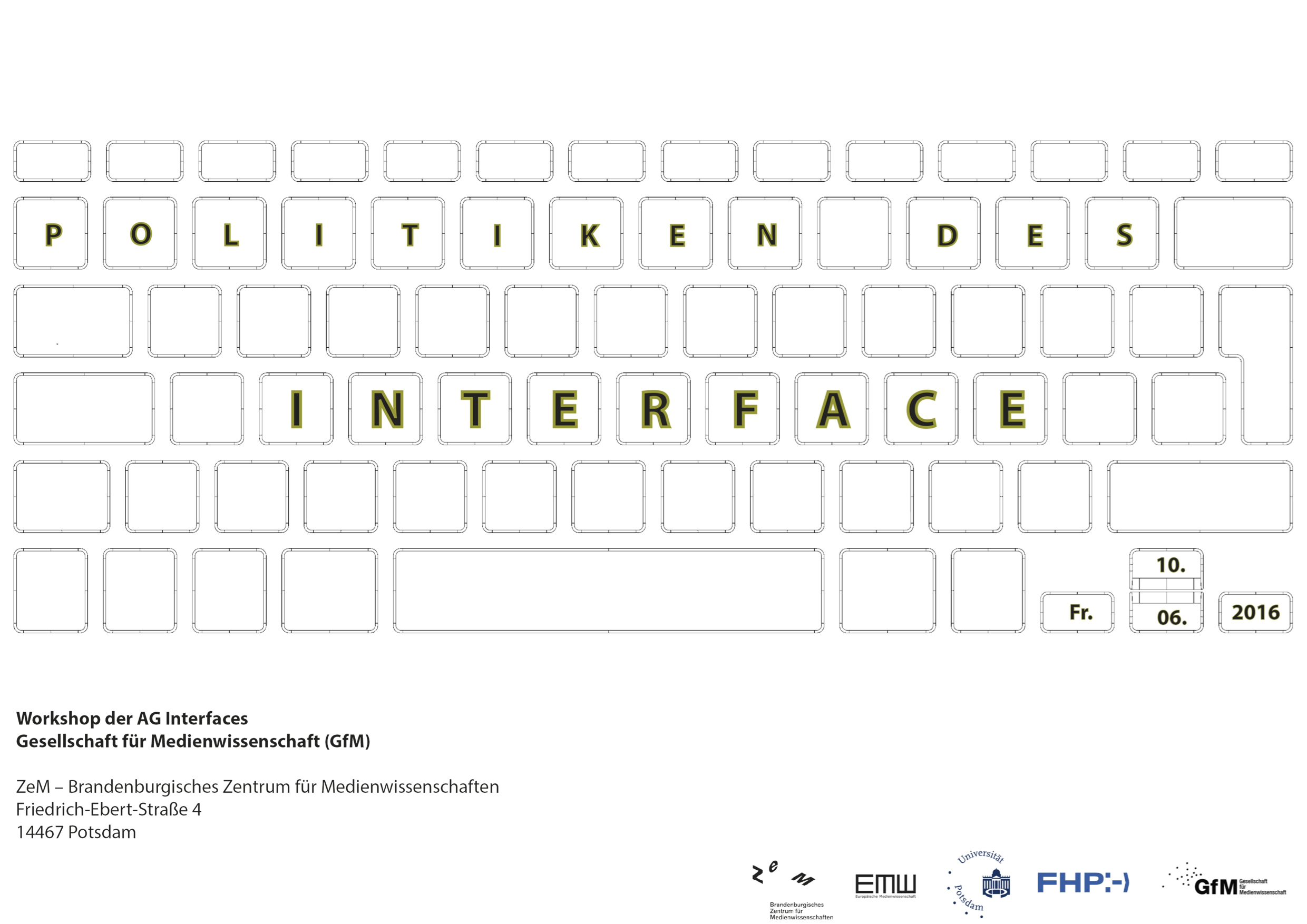
„Politiken des Interface“- 1. Workshop der AG Interfaces

PdI_Front_A3

Datum: 10. Juni 2016
Ort: Potsdam
Veranstaltungsort: ZeM (Brandenburgisches Zentrum für Medienwissenschaften)
Friedrich-Ebert-Straße 4
14467 Potsdam
Veranstalter: AG Interfaces in Kooperation mit dem ZeM; Organisation: Jan Distelmeyer, Timo Kaerlein, Sabine Wirth
Vortragende: Jan Distelmeyer, Florian Hadler, Joachim Haupt, Sabine Wirth, Boris Müller, Timo Schemer-Reinhard, Bianca Westermann, Regina Ring, Timo Kaerlein, Jana Herwig, Sophie Ehrmanntraut

PdI_Programm_A5

Continue reading

Tagung „(un)sichtbar machen. Kulturwissenschaftliche Perspektiven auf Hüllen und Enthüllung“

Ort: Hamburg
Veranstaltungsort: Warburg-Haus, Heilwigstraße 116, 20249 Hamburg
Veranstalter: Isa Lohmann-Siems Stiftung, Leitung: Inga Klein, Nadine Mai, Rostislav Tumanov
Datum: 19.02.2016 – 20.02.2016


Hüllen und Enthüllung provozieren gleichermaßen sinnliche, intellektuelle und imaginative Assoziationen und Auseinandersetzungen. In ihrer Materialität, aber auch in ihrer performativen Struktur und als Akt der Kommunikation generieren, bündeln und steuern sie Aufmerksamkeit. Dinge, Körper, Ideen zu verhüllen oder zu exponieren – sie (un)sichtbar zu machen – sind Prozesse, die eine Dialektik zwischen Innen und Außen organisieren. Das zeigt sich nicht nur in idealisierten Produktpräsentationen und -verpackungen, sondern auch in (Ver-)Kleidungen, Praktiken des Blendens oder verhüllenden Bildwerken.

Die interdisziplinäre Tagung spürt den materiellen, medialen und praxeologischen Qualitäten des „(un)sichtbar machens“ nach. Wie gestalten sich die Beziehungen zwischen Hüllen, Verhülltem und Betrachtenden, die Ambivalenz von Sehen und Nichtsehen? Welche Symboliken und Wertzuschreibungen finden sich in den Hüllen, welche in der Enthüllung? Welchen Regelmäßigkeiten und Bedingungen folgen Prozesse der Ver- und Enthüllung?

Continue reading